Under Banner of Resisting China, What is Taiwan Losing?
United Daily News Editorial, August 24, 2026
Since taking office, the administration of President Lai Ching-te has imposed restrictions on cross-strait exchanges on virtually every front—from issuing travel advisories for mainland China and restricting mainland tourists from visiting Taiwan, to limiting cross-strait student exchanges and travel to the mainland by civil servants. More recently, it blocked access to the “Taiwan Youth e-Home” website established by the Taiwan Affairs Office (TAO) of the mainland’s State Council and even mobilized four government agencies to investigate a mainland-made heavy motorcycle that was never intended to enter Taiwan’s consumer market.
Behind these restrictions, all imposed in the name of national security, lies a deeper fear: that what Taiwanese people learn about mainland China might overturn the narrative constructed by the Lai administration. In building a wall between the two sides of the Taiwan Strait, the government has instead placed itself in opposition to businesses and industries across society.
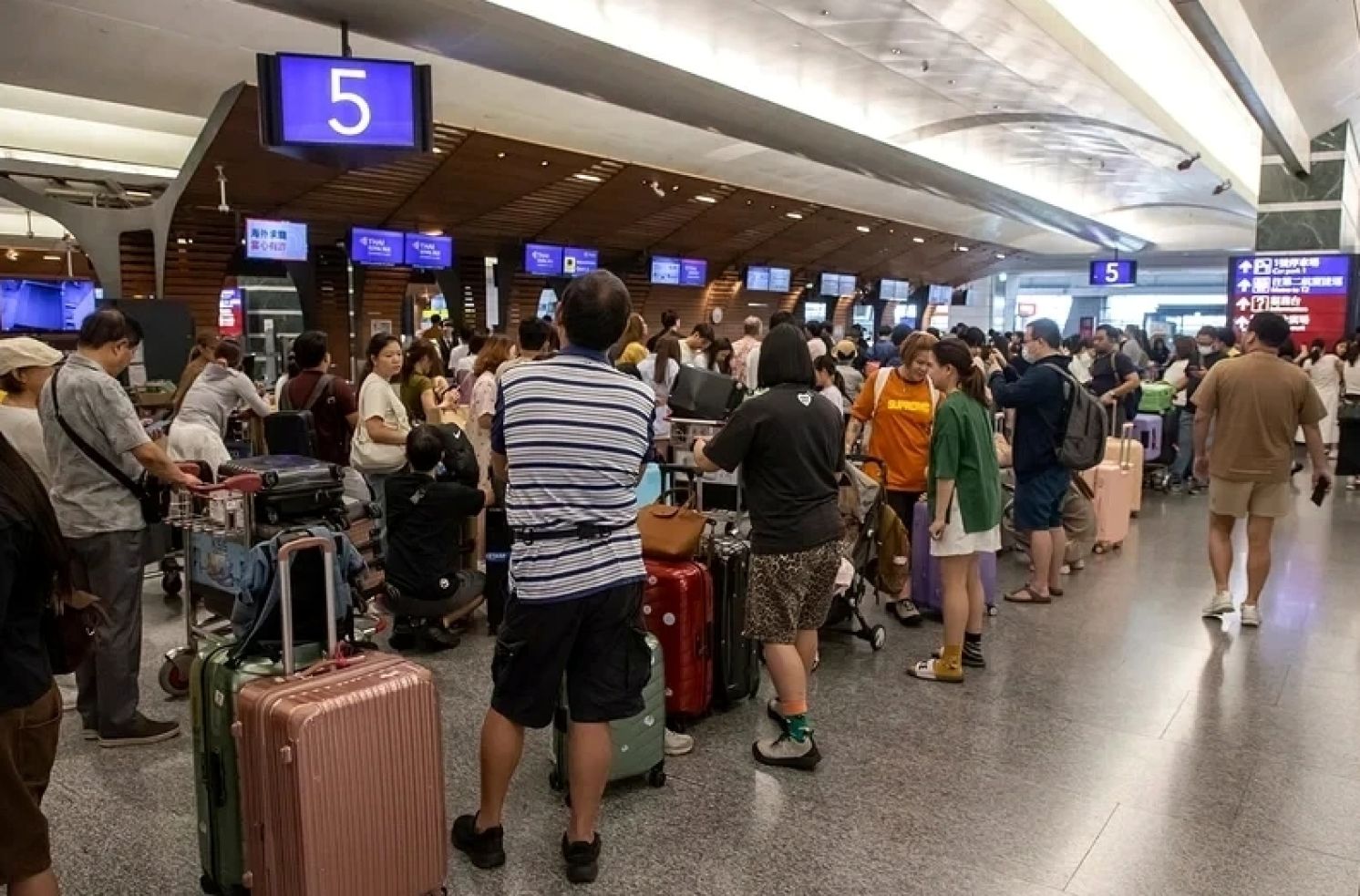
Taiwan’s tourism sector faces a severe structural imbalance. Last year, Taiwanese made as many as 18.9 million outbound trips, while only 8.5 million international visitors came to Taiwan, widening the tourism deficit to NT$700 billion (about US$22.1 billion). The situation has become even more serious this year. The Lai administration has set a target of attracting 10 million international visitors, yet ironically, outbound travel surpassed 10 million trips in the first half of the year alone for the first time, while inbound arrivals totaled just 4.29 million. One major factor, of course, is the absence of mainland Chinese tourists, which has affected a wide range of upstream and downstream industries.
Meanwhile, although the ban on tour groups traveling to mainland China remains in place and the Mainland Affairs Council (MAC) has repeatedly warned Taiwanese travelers of the risks of going to the mainland—including disappearance, questioning, or restrictions on personal freedom—statistics from the TAO show that 2.8 million Taiwanese visited mainland China in the first half of this year, an increase of nearly 25 percent from the same period last year. Despite the government’s repeated efforts to raise the cost of cross-strait exchanges and intensify psychological deterrence, it has been unable to change the reality that people-to-people exchanges across the Taiwan Strait are becoming increasingly extensive.
Moreover, the Ministry of Education (MOE) has repeatedly ordered universities to ensure that students’ exchanges in mainland China are properly reported, warning that failure to do so could affect institutional evaluations and government subsidies. Together with the MAC, it has also promoted “Understanding China” courses and teaching materials at schools of all levels. Critics argue that these materials seek to shape students’ national identity, effectively turning the MOE into an anti-China education agency.
Such restrictions have recently become even more aggressive. Not long ago, the MAC blocked access to “Taiwan Youth e-Home,” a platform established by the TAO to provide Taiwanese young people with information about studying, internships, employment, entrepreneurship, and daily life in mainland China. The MAC cited violations of the Act Governing Relations between the People of the Taiwan Area and the Mainland Area as well as concerns over personal-data security.
But apart from creating inconvenience, can blocking the website really stop Taiwanese young people who want to study or work in mainland China? Judging by the trend in cross-strait people-to-people exchanges, the MAC’s approach may amount to little more than burying its head in the sand.
Recently, a Taiwanese individual purchased a (ZXMoto) 820RR motorcycle made by mainland Chinese brand Zhang Xue, a model that has won a race in the World Superbike Championship. The motorcycle was disassembled into components, shipped to Taiwan in separate batches, and then reassembled domestically. The bike was tested only on a racetrack; it was neither registered nor intended for use on public roads. Nevertheless, the case prompted several government agencies, including the Ministry of Economic Affairs and Ministry of Finance, to jointly seize the motorcycle, sparking a backlash among Taiwan’s heavy-motorcycle community.
The Lai administration may reasonably remind the public of potential risks. But by repeatedly invoking national security to create obstacles to cross-strait people-to-people exchanges and attempting to reduce opportunities for interaction between people on the two sides, it is doing something quite different. While the government claims that such measures are intended to protect domestic industries or prevent personal-data leaks, its deeper fear is that once Taiwanese people see the advances mainland China has made in technology, industry, and other fields—including its ability to manufacture world-class vehicles at competitive prices—the long-standing information bubble portraying the mainland as backward and uncivilized may begin to collapse.
Driven by these fears, the Lai administration continues, for ideological reasons, to put itself at odds with ordinary people and businesses across a broad range of industries. The question is: Is this a carefully calculated political strategy—or a serious miscalculation?